Showing posts with label g. Show all posts

Sunday, July 25, 2010

Alan Wake


Alan Wake Review: A Beautiful Nightmare by Remedy

Max Payne was revolutionary. Despite the numerous delays the game suffered, it fed into the frenzy of action/combat that had been crafted out by the Wachowski Brothers-Matrix phenomenon. The game also brought forward a unique style of storytelling narrative which combined noir sequences in a stylish graphic novel format to forge an alternative to a regular barrage of cut-scenes that were seen in most action games of that day and age.

After Remedy completed the sequel to their hit game, they started working on a project called “Alan Wake.”The game, many believed, would be the next step in evolution when it was announced in 2005. However, the numerous delays the game suffered mad

e one forget about the existence of the title t

ill it resurfaced at last year’s Electronic Exposition. So where does “A-wake”, as it is fondly dubbed, stand in a generation that has seen the horrors of the Locust Horde, Urobors and the artifact nestled in Ishimura.

Alan Wake does not suffer from insomnia for starters, the whole bit of him being A-Wake has been dropped to accommodate a regular survival horror story that is both satisfying and convoluted. The basic premise is that of a writer who models himself after Stephen King and his wife (Alice) visiting a place called Bright Falls. After a mishap Alice disappears from the cabin where they were put up and thus Mr Wake begins his treacherous quest to locate her. There can

not be much said about the plot in the review since it holds the ga
me together and it is clear from the onset that

Remedy has spent a significant amount of time and effort in crafting a rather intricate premise.

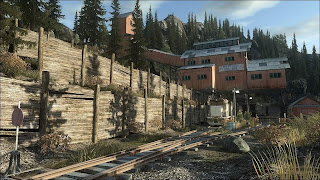
As beautiful and idyllic is Bright Falls under the glinting sun, it beco

mes a horror fest in the dark. Light and Dark is the basic structure that holds all the gameplay mechanics together in Alan Wake. All equations in the game hinge on these two primary

aspects which have been translated into gameplay mechanics. The town of Bright Falls has been engulfed by an entity called “The Dark Presence” and is slowly transforming its inhabitants into what the Alan terms as “The Taken”.

In true video game fashion, Alan Wake uses the light to exorcise The Taken scattered throughout the game and subsequently puts an end to their misery by using bullets to decimate the dark presence that has engulfed them from sanity. As mundane as it may sound, the game paces the enemies in quite an exhilarating manner. Not only does the variety of the taken keep improving as episo

des go by, the threat and fear that they are to instill during the playthrough also increases subsequently. The dark presence does not restrict itself

in engulfing human entities, there are a significant number of objects that are scattered through the game (tractors, bulldozers, giant mine carts, iron beams, cars) that also confront the player on numerous occasions.

To aid Alan’s quest, he is introduced to a flashlight, which

is used to weaken the physical manifestation of the dark presence of the Taken, then he uses his trusty arsenal (a revolver, flare gun or a shotgun/hunting rifle) to obliterate them from the face of the planet and what remains vaporizes into thin air. This is the basic gameplay mechanic that c

onstructs the action sequences throughout the game. Alan Wake also intersperses vehicular segments to add variety to playthrough experience.

These sequences also add the dimension of light and dark into it and mirror driving sections from any open world game. The difference lies in the utilization of the vehicle’s headlights to exorcise the Taken and crushing them with the brute force of metal. If most remember the initial gameplay structure whe

n Alan Wake was announced, it was designed to be an open world game with modules of exploration. The vehicular sequences, we assume, have been retained from that structure of the game and hence feel quite out of place. The reason why this is being emphasized is because the

re are numerous areas where the game breaks into cutscenes to emphasize on a driving section which could have been reconstructed into an actual gameplay sequenc

e.

The mechanic that is used to destroy The Taken is rather straightforward. The light beam is a replacement for the targeting reticule found in all action games, and focusing the light beam on the enemy is reminiscent of the pull back mechanism that has become a rather standard method in third person shooters. Though this may sound repetitive, the developers have added a few gameplay mechan


ics to ke

ep combat fresh, tense and be in line with survival horror.

The player constantly needs to keep reloading not only his gun but also his flashlight during combat by pressing keys. The reload mechanic is eerily similar to reloading a chainsaw bayonet from Gears of

War. Though the sequence is not timed, the player needs to constantly keep a check on the ammunition that he has and the state of the batteries that are being used in the flashlight. The flashlight’s battery is not utilized when Alan wake is moving about, but when the playe

r starts to focus on an enemy to exorcise the Taken it starts to deplete swiftly, the player needs to keep in mind both these gameplay mechanic during combat.

As episodes progress, the enemies also grow stronger and faster and both require a hefty amount of light mechanics to exorcise the darkness that shrouds within them. The enemies also vary from human beings from various walks of life, the regular ones are the easiest to exorcise and kill and as the game progresses Alan if faced by the cops, hunters and miners who are lunging to engulf him into the twilight zone. The ones that top this bunch are the birds that swoop down on Wake on numerous occasions and only a well timed flare can save him from being consumed by them.

The best part about Alan Wake is its method of introducing players to a narrative, since the plot is entrenched on the fact that whatever Wake has penned down is coming true. The player often finds himself collecting manuscripts that have been scattered across the game, these help in piecing together sequences that often are to occur in a game. During our

playthrough there were numerous occasions when we thought we were going to experience what we had discovered in one of the manuscript pages only to be confronted by something else and other segments saw us witnessing the horror that had been penned down by the deranged writer.

The narrative also relies on radio broadcasts to explain a similar set of pre and post occurrences of events through the game. It feels good to see a lot of loose ends being tied up in an episode, if the player actually has the patience to hunt for all the clues that are scattered all around. There is also a television show titled “Night Springs” (a doppelganger for Bright Falls) which is as eerie and bizarre as the plot of Alan Wake. Besides the show there are television segments that star Alan Wake himself and help to progress the plot. Though the method of delivering the narrative is strong and effective, the dialogue is generic and in no way represents the concept of a writer. Most of it is actually random and takes away from the immersion factor that has been built on during delivering the narrati

ve.

Alan Wake’s visuals are a mixed bunch, they are nice and crisp when the game is rendering in game cut scenes but this visual fidelity loses its ground during actual gameplay. The shadows that lurk in the dark aptly act as puppets of horror and often give players a thrill. These become more enticing in sequences when Alan has to cut across using no weapons. The chase that follows in the dark and gloomy forest showcases the beauty of the game at various levels. The visuals only seem to be hampered by the awkward animation mechanics in the game, since we have been spoilt by the likes of Uncharted 2 and its silky smooth almost human like transition during action, witnessing pieces of rugged sequences in Alan Wake look a tad bit disappointing.


The lighting effects are worth a dekko in the game, we can only go gaga over the moon glinting in the sky to the flares that illuminate the entire screen when they are used. These somber moments in the game are complemented by the soundtrack that plays in the background. However the main gripe that occurs with the sound is the fact that whenever there is bunch of enemies that are going to devour Wake, it switches tracks making it fast and furious, this often leads to a generous giveaway of being attacked by the player.

The Final Word: Alan Wake does not utilize any original mechanic, the episodic mechanic has already been witnessed in the latest version on Alone in the Dark. The utilization of light to weaken and exorcise enemies was seen in a game called “Obscure” that was released last generation. This coupled with the games random story and terrible short length makes it lose brownie points. However, Remedy polishes these mechanics and presents a wonderful package to its community that deserves applause in the world which is constantly being engulfed by the “shooter cum multiplayer phenomenon.”

Devil Summoner 2

The Japan of the mid to late 1920s was a unique blend of the old and the new as the island nation struggled to maintain its traditions in the face of rampant modernization. Shin Megami Tensei: Devil Summoner 2: Raidou Kuzunoha vs. King Abaddon uses this turbulent period of history to great effect, crafting a moody and atmospheric world to tell an intriguing and stylish story. Though the game suffers from inconsistent and sometimes confusing gameplay and a flawed exploratory camera, its engaging battles, addictive devil management system, and low price point make a solid case for role-playing game fans to plug their PlayStation 2 consoles back in to make a deal with a devil.


When the Yatagarasu, the shadowy organization that watches over the sanctity of Japan, has reason to believe an imminent threat is approaching Tokyo, it's up to Raidou Kuzunoha to step in and save the day once again. The young Raidou--the 14th person to assume the title of the greatest devil summoner--is dispatched to the capital to keep an eye on it and take what steps are necessary to avert disaster and maintain the balance of the supernatural world. Along for the ride is Raidou's chatty and often sarcastic feline companion-slash-mentor, Gouto, and serving as the cover for their operations once again is the Narumi Detective Agency, which is run by the carefree and decidedly dapper modern gent Shouhei Narumi. When a lovely but suspicious dame hires you to find a man named Dahn, what looks like a simple missing-persons case turns out to be anything but, and Raidou is thrust into the middle of a mystery that involves masked ninjas, giant insects, and a whole lot of bad luck.

As a devil summoner, dealing with the supernatural is Raidou's specialty, and with all the strange happenings in the capital, there's no shortage of it. While investigating for clues, he frequently stumbles across wandering devils that need to be put in their places, and calling in demonic backup of his own is where Raidou's talents really lie. Up to two devils can be summoned at a time, and by paying careful attention to your enemies' weaknesses and calling upon the right friends to take advantage of them, you can dish out some serious damage. Watch out, though, because your devils have their own weaknesses, and enemies won't hesitate to take advantage of them. You can't just let your devils do all the work, and thankfully Raidou is more than equipped to hold his own in a tussle. Getting up close and personal to show off his swordplay is his primary source of damage, and he's also a crack shot with a revolver, which hits for less damage but can stun rogue devils. Combat is in real time, and Raidou is surprisingly nimble on his feet, which makes dodging incoming hits as easy as dive-rolling out of the way.

Though pursuing the path of violence is fun with this battle system, it's not always the best course of action: sometimes it's better to chat up your enemies instead. Through careful application of the art of negotiation, you can recruit a devil to your side, provided it's in the mood and you satisfactorily answer its line of questions and comply with its demands. Constantly expanding your chthonian roster is important, because you grow as a devil summoner by gaining loyalty from your devils. Loyalty is earned by taking your devils into battle, which in turn increases the number of devils you can keep at a single time and grants Raidou higher ranks (which determines what side quests you can accept). It's also important to keep a diverse portfolio of devils, because each one has different field abilities that help with your detective work--the pagan Lilim, for example, can read minds, a power that helps you glean information that you would otherwise be unable to obtain.

When not sweet-talking or pounding on devils, Raidou busies himself by running around the various districts of the capital searching for clues. Despite the detective shtick Devil Summoner 2 has going for it, these are the weakest parts of the gameplay because your immediate goals often aren't well communicated, and there are often long stretches without combat. Furthermore, each area is displayed from a fixed camera location, and every so many steps the camera moves to a different spot. Seeing the same scene from multiple different angles can be disorienting, which makes even navigating around the world an exercise in frustration.

If you need a break from mundane story investigations, you can always return to the detective agency and pick up some of the extra case files that build up on your desk and gather dust. While most of these side quests are simple fetch missions, some of them send you to specific locations to track down and dispatch more powerful devils, and others reward you with new abilities you'll need in order to push on in the main game. You can also spend time in the dark versions of the capital to tame more devils to add to your collection, which can then be fused together two at a time to create entirely new ones in the laboratory of the Dr. Frankenstein-ish Victor, a quirky but friendly demonologist. Victor can also synthesize new weapons for you, and using either of his services can be fun and rewarding in and of itself.

The rich game world is brought to life with the Shin Megami Tensei series' trademark stylized designs and a jazzy, upbeat soundtrack. Unlike in the recent Persona games, which favored an anime look and feel for the characters, everyone in Devil Summoner 2 is rendered and animated in full 3D. Though Raidou and company look great, they're all suspiciously silent due to a complete lack of voice acting, which makes for some awkward moments during conversations. Nonetheless, the entire game positively oozes with style, which more than makes up for this and the slightly aged graphics produced by the PS2 hardware.

Though it suffers some missteps from the lackluster investigation sequences and poor camera, Shin Megami Tensei: Devil Summoner 2: Raidou Kuzunoha vs. King Abaddon is an engaging and suspenseful adventure through an atmospheric world filled with supernatural intrigue. Fusing devils or recruiting new ones is addictive, defeating powerful fiends is rewarding, and unraveling the story is entertaining. If you're looking for a quirky and fun game to slake your thirst for an RPG, Devil Summoner 2 may be just what you're looking for.

HAWX 2 Hands-On

Tom Clancy's HAWX 2 Hands-On

Tom Clancy's HAWX 2 puts you back in the cockpit of various modern or cutting-edge fighter planes, though this time the aerial combat is split across US, Russian, and British campaigns. The story isn't a direct continuation of the first game's mercenaries-versus-US plot, but it has "much more depth," according to narrative director Edward Douglas, thanks to its multiple international perspectives. Though the plot isn't laid bare in our demo, we gather it involves mounting insurgent activity in the Middle East and Russia. As the game begins, a nuclear missile has disappeared from a Russian military base, and in the tutorial mission Contact (described in our first look at the game), an insurgent convoy launches an attack on a US air base in a desert at the edge of the conflict.

Too close for missiles, I'm switching to guns.

The most obvious difference from the first game is the presence of takeoffs and landings, including taxiing to the base runway in the first mission; in 2009's HAWX, missions began and ended in the air, with your plane already cruising towards your waypoint. "We want to give you the full experience, from when the pilot gets in the plane to when he gets out again," said Douglas. "In HAWX 1, you spawned in in third-person view in the air, the missions ended that way, you never knew who you were or why you were there."

That fuller, more authentic experience of modern air warfare goes further than runways and landing gear, adding aerial espionage with unmanned aerial vehicles, stealth missions with night raids, and gunship missions to the mix, as well as midair refuelling and precision bombing. We jumped ahead in the campaign to Interception Course, set in southern Russia, where separatist leaders have been surrounded and pinned down in the Caucasus Mountains. Separatists, meanwhile, had captured a Russian military base and taken cargo planes and bombers and were en route to rescue their leaders.

As a Russian military pilot in a Mig-29 Fulcrum, armed with heat-seeking missiles and flares, we flew with our squad to intercept the rescue attempt. The basic flight controls in HAWX 2 are mostly unchanged, and the same first-person cockpit view and third-person view from just behind the tail are available, along with the "assistance off mode," which flips you into a remote perspective some way behind your plane and enables more advanced manoeuvres (though at the risk of stalling as you attempt them).

After lining up to intercept and then delivering a final warning to the separatists, our squad was ambushed by a swarm of fighter planes, triggering an all-out dogfight over the peaks of the snowcapped mountain range. This combat resembles the familiar patterns of HAWX before long--circling, air-braking, tracking targets to get a missile lock-on--but is occasionally broken up by more inventive enemy AI; in this mission, enemy pilots tended to get in close, making lock-on trickier, and tried to outmanoeuvre us through the steep-walled valleys. Unlike in the first HAWX, there's no system for issuing commands to AI wingmen, but the whole game will be playable in up to four-player co-op.

"We're really trying to make dogfights a lot closer, more personal," said Douglas. "The way the weapon system works will encourage you to fight at different ranges, different AIs will use different tactics… some will use flares more, [for some] you'll have to use cannons versus fire-and-forget missiles."

The rocky, mountainous terrain, partly obscured by clouds, looks good, as do the grass and trees further down the slopes; a low flyover doesn't expose the kind of blocky textures present in the original game. As in HAWX, though, the game maps draw on real satellite data, with some as large as 130km by 130km.

After taking down the separatist fighters, we were denied permission to return to base by a presumably soon-to-go-rogue Russian general, who bemoaned weak-willed politicians and told us to refuel instead so we could defend a Russian withdrawal from the region. This set our objective on a distant tanker aircraft, requiring that we match speeds and line up with it by flying through a green hoop in midair--an element of the augmented reality pathfinding Enhanced Reality System (ERS) left over from the original game.

The ERS is gone from the general dogfighting, however, meaning you won't be pursuing targets through a series of hoops. "We found the ERS was very helpful in the first HAWX to find other players and ground targets in dogfights," said Douglas, "[but] we found the air combat mechanics we developed for the second game got to a better level where… we didn't need nearly so many assists and handholding for the player. It's still there for landings and certain precise bombing targets, if you want assistance." With a five-minute time limit to refuel, we had to approach the refuelling craft with gradual acceleration and delicate, precise manoeuvring--a change of pace from the wild, wide loop-the-loops we generally navigate our dogfights with.

Jumping ahead again to another American mission, Oil City, we were back in the pilot seat of a US fighter, packing air-to-surface missiles and heat-seekers and launching from the deck of a US aircraft carrier. The mission, set over the ocean at sunset, had us defending friendly forces by taking out antiaircraft sites on oil rigs and shooting down enemy helicopters. This meant prioritising targets that were threatening friendly units, flipping between missile types, and picking off targets as the health percentage of our allies ticked down.

Make sure your seat and tray table are in their full upright position.

Once the helicopters were down and antiaircraft sites near the oil rig's airstrip had been subdued, the strip became available for landing. This meant lining up, adjusting pitch, and lowering landing gear for touchdown. There isn't the depth or complexity of a full-on flight sim, but we're told later missions will add further challenge to takeoffs and landings. We're told in the final game these will range from straightforward runway affairs to nighttime aircraft landings and emergency takeoffs under fire, and other missions in the game will allow for landing and rearming mid-mission.

Like the original HAWX, it seems HAWX 2 aims to combine arcadey accessibility with the sheen of Tom Clancy near-future military authenticity. And, between expanding the experience to refuelling, takeoffs, and the like, adding in mission types, and advancing the enemy pilot AI, it should do so with greater variety come September 3, 2010.